

Here’s a situation I’m fairly certain every one of us has experienced:
You have a task to do, something that should get done soon. The sooner, the better. The first day you remember, you plan to do it. However, something comes up that day and you don’t get it done.
You feel some anxiety about not getting it done. Every time you think about this task, there’s anxiety associated with doing it. There’s self-imposed pressure to get it done. Days pass by and you forget to do it. Every time you have free time, the task is forgotten. It always pops up as a reminder at the wrong time, adding a little bit of stress to your mental state.
You are procrastinating.
One day you decide enough is enough. You force yourself to sit down and knock the task off. During and upon completion, you realize it wasn’t nearly as bad as you thought it would be.
Why does this happen
It feels silly when it gets completed. Whenever this happens to me, I feel as if I’ve wasted a good amount of time and energy thinking about and stressing over the task - given the true difficulty of performing it.
First, what is procrastination? Let me try to formalize it in a useful way.
Procrastination is a pattern of emotional avoidance where an attempt is made to avoid an emotion by refraining from the action that the emotion is associated with.
In other words, the feeling is what is being avoided, not the action itself. The most insidious part? Most of the time that feeling is anxiety over not doing the thing, like in the situation above. It looks something like this:
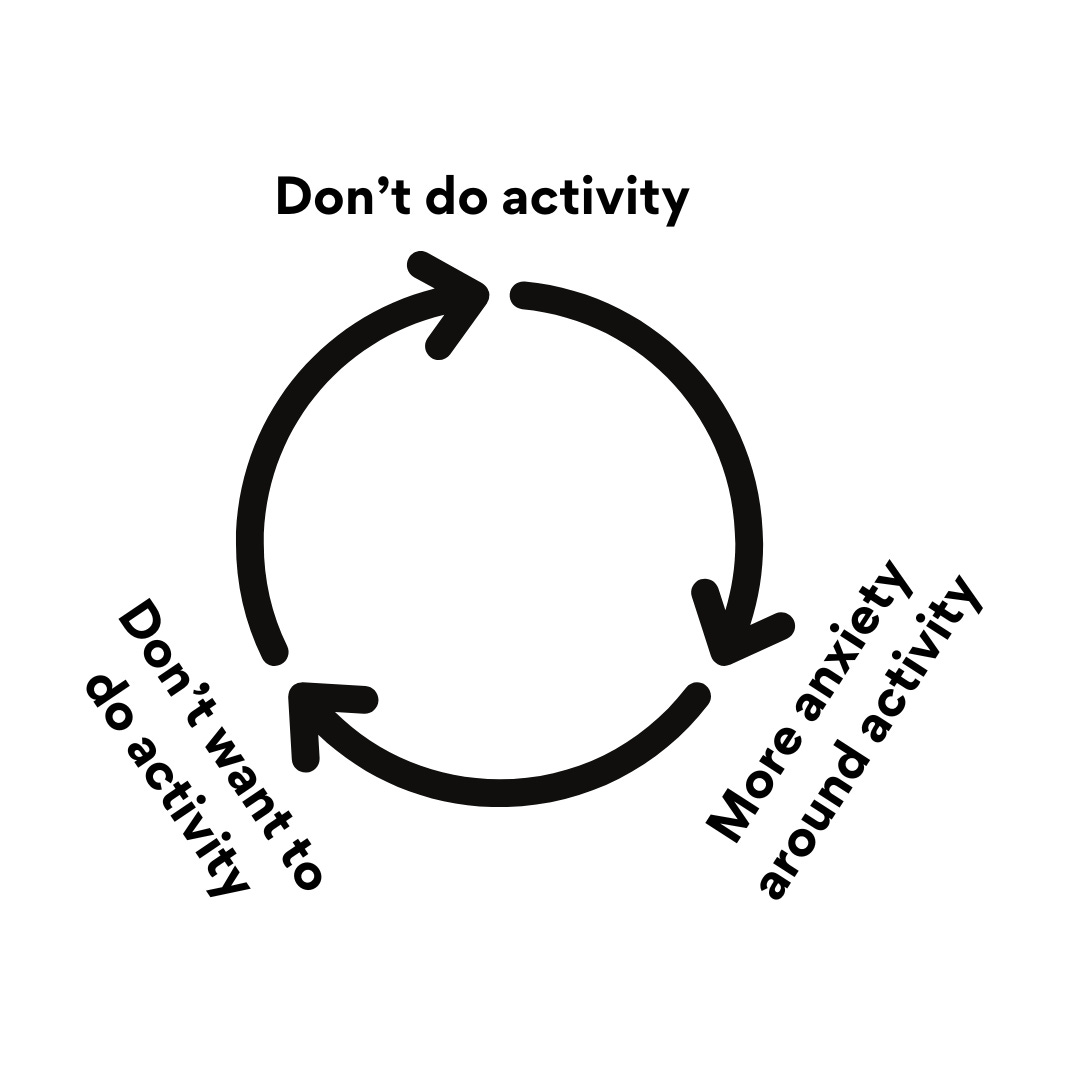
It’s a positive feedback loop that usually continues until you:
Forget about doing it.
Are forced to do it by a deadline.
Recognize the loop.
Those are the three options. (1) will be the most prolonged and anxiety-inducing, (2) the next most. (3) is the ideal first step - though there’s still some work to do.
After recognizing the loop
Recognizing the loop sounds great, but it doesn’t nullify the emotional experience that still exists due to the attached anxiety. In my experience, explaining logic to emotions doesn’t work.
What I suggest here is that the emotion is targeted, not the action. The action is only daunting because of the emotion itself, so the loop can be broken by fixing the emotional avoidance first.
Start by acknowledging the action itself. This will likely bring up a lot of anxiety, fear, shame, guilt, or whatever other emotion was connected to the action. Recognize that these are separate from the action. Allow them to exist - try to sink into them and feel them fully. Watch as they slowly subside in your mind and body.
If you feel ready to take on the task, go ahead and do it! If not, notice again what comes up when you think about doing it. Continue this process and see that the response gets weaker and weaker. Finally, you should be able to start your task with almost no friction.
Why
Why not force the action? First, it may not work in getting the action done, if the response is high enough.
The other, bigger issue is that in forcing the action, we are still avoiding the same emotion, just in a new way. Upon completing the task, anxiety has not been processed and therefore does not go away. Instead, it remains as chemicals in the body, waiting for the next stray thought to attach to. This starts a whole new cycle of procrastination. Just feel it.